
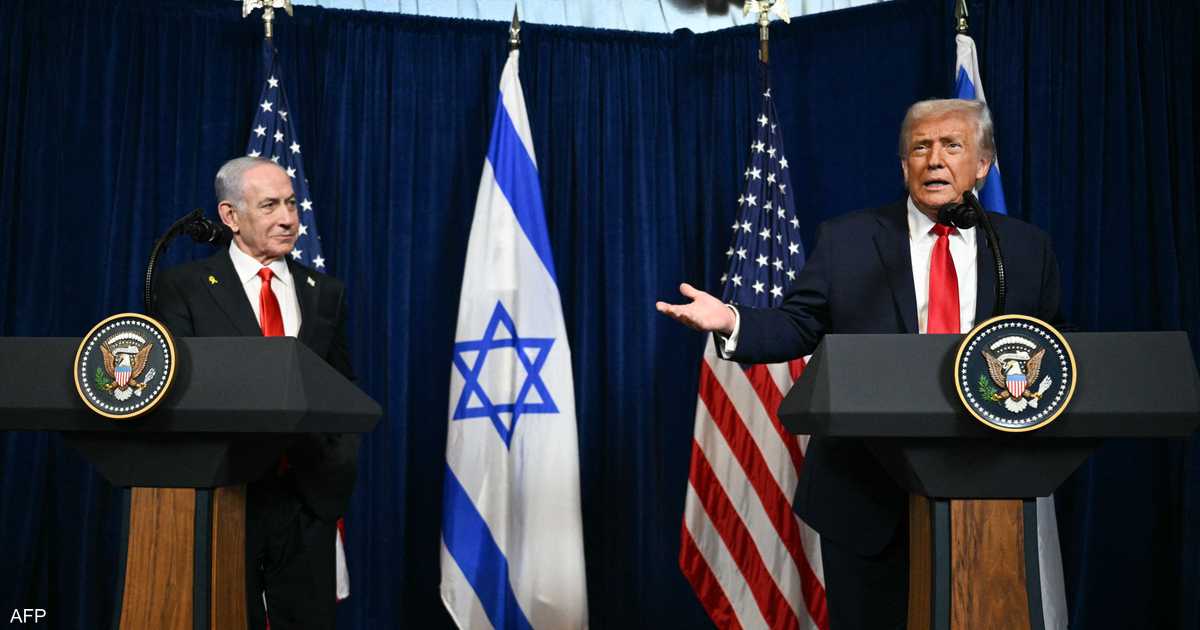
Despite the shared American-Israeli assessment that Iran constitutes a common threat, divergences in strategy have emerged between U.S. President Donald Trump and Israeli Prime Minister Benjamin Netanyahu regarding the handling of this issue.
Netanyahu advocates for expanding negotiations with Tehran to include Iran’s ballistic missile program, whereas Trump has not publicly committed to such an expansion, limiting his comments to the possibility of discussing missiles alongside the nuclear file.
Israel expresses concern over a potential nuclear agreement that might be limited to uranium enrichment and ignore other “red lines.” Conversely, Washington appears focused on establishing a framework that restricts enrichment to peaceful levels.
Furthermore, Israel demands that any agreement include the cessation of Iranian support for its regional proxies, such as Hezbollah in Lebanon, the Houthis in Yemen, and militias in Iraq. In contrast, the U.S. focus remains primarily on the nuclear track, without showing a clear commitment to linking the deal strictly to regional arms.
Additionally, Israel is apprehensive about Tehran’s efforts to rebuild its air defense systems and missile arsenal following previous strikes. The American stance, meanwhile, prioritizes preventing nuclear weapons possession but lacks a clear mechanism to halt the rebuilding of conventional military capabilities.
This fundamental divergence in public positions between Washington and Tel Aviv may explain the nature of Trump’s recent meeting with Netanyahu, which was held behind closed doors without a formal protocol. Some observers suggest this could be a calculated game of role-playing between the two sides.
Regarding the meeting, Netanyahu stated to reporters before leaving Washington: “He wanted to hear my opinion; and I won’t hide from you that I expressed general doubts about the nature of any agreement with Iran. However, I said that if an agreement is indeed reached, it must include elements very important to us – to Israel – and I believe not only to Israel. This means it should not be limited to the nuclear file alone, but should also include ballistic missiles and Iranian agents.”